Iran Power Structure: Who Was Khamenei and Who Holds Real Power?
Iran’s political system is one of the most unique in the world. It combines religious authority with democratic institutions. While the country has elections and a president, the ultimate authority lies with a powerful religious figure known as the Supreme Leader. For decades, that position was held by Ali Khamenei, who shaped Iran’s domestic policies and its foreign conflicts with countries such as the United States and Israel.
Understanding Iran’s power structure is essential to understanding why the country often clashes with Western nations and how its internal leadership influences global politics, energy markets, and stock markets.
The Structure of Power in Iran
Iran’s political system is built on the concept of “Velayat-e Faqih,” meaning the rule of Islamic jurists. This system was established after the 1979 Iranian Revolution, which replaced the monarchy with an Islamic Republic. Under this structure, religious leadership oversees elected institutions.
The key institutions include:
• Supreme Leader – the highest authority in the country • President – elected by the people • Parliament (Majlis) – responsible for legislation • Guardian Council – supervises laws and election candidates
Despite the presence of elections, the Supreme Leader stands above the executive, legislative, and judicial branches and has the final say on national policy.
Who Was Ali Khamenei?
Ali Khamenei was one of the most influential leaders in modern Iranian history. He served as Iran’s president from 1981 to 1989 and later became the country’s Supreme Leader in 1989 after the death of the Islamic Republic’s founder.
As Supreme Leader, Khamenei held authority over the armed forces, the judiciary, state media, and strategic decision-making bodies. His position gave him ultimate control over Iran’s military strategy, foreign policy, and national security decisions.
During his leadership, Iran strengthened alliances with regional groups and expanded its influence in the Middle East, often putting it at odds with Israel and the United States.
Who Holds Power in Iran Today?
In Iran’s political hierarchy, the Supreme Leader remains the most powerful figure. The leader is selected by the Assembly of Experts and can serve for life.
Even though Iran has a president and parliament, major decisions—especially regarding military action, nuclear policy, and foreign relations—are ultimately controlled by the Supreme Leader and powerful institutions like the Islamic Revolutionary Guard Corps (IRGC).
In times of crisis or war, the IRGC plays a major role in strategic and military decisions, making it one of the most influential forces in Iranian politics.
Why Iran Has Conflict with Israel
The rivalry between Iran and Israel is rooted in ideological, political, and strategic differences.
First, Iran strongly supports Palestinian groups and opposes Israel’s policies in the region. This ideological opposition has been a key part of Iran’s foreign policy for decades.
Second, Israel sees Iran’s nuclear program as a major security threat. Israel and its allies believe Iran may attempt to develop nuclear weapons, something Iran officially denies.
Third, both countries compete for influence in the Middle East. Iran backs various regional groups, while Israel tries to counter Iranian influence across the region.
Why Iran and the United States Are in Conflict
The conflict between Iran and the United States dates back to the Iranian Revolution of 1979. After the revolution, Iran’s new Islamic government replaced the pro-Western monarchy and relations with Washington deteriorated rapidly.
Several major factors drive tensions between the two countries:
• Iran’s nuclear program and sanctions imposed by the US • Strategic rivalry in the Middle East • US support for Israel and Gulf allies • Iran’s support for regional militant groups
These issues have created decades of hostility and periodic military confrontation.
Latest Situation in the Iran-Israel-US Conflict (2026)
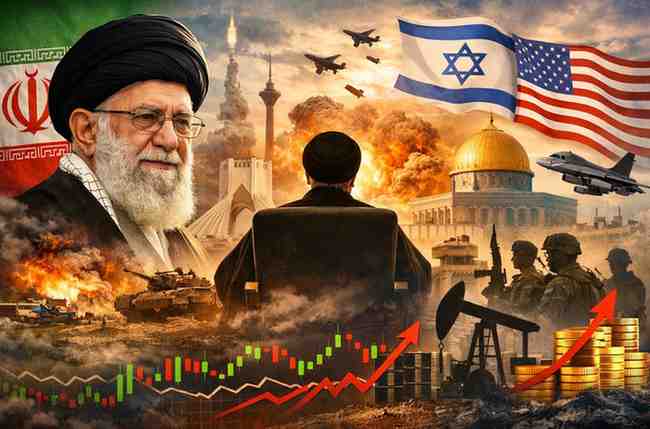
Recent events have intensified tensions in the Middle East. Reports indicate that coordinated strikes by the United States and Israel targeted Iranian facilities, leading to a broader conflict in the region.
Iran responded with missile and drone attacks while attempting to disrupt regional energy infrastructure, a strategy aimed at putting economic pressure on Western nations.
At the same time, tensions around the Strait of Hormuz—a route used for roughly 20% of global oil supply—have raised concerns about energy security worldwide.
How Global Stock Markets Are Reacting
The conflict has had a noticeable impact on global financial markets. Rising geopolitical risk pushed oil prices higher, which often leads to inflation concerns and stock market volatility.
During the height of tensions, oil prices surged close to $120 per barrel before falling again after signals that negotiations could reduce the conflict.
Energy and defense stocks have gained investor attention, while broader markets experienced temporary sell-offs due to uncertainty about global trade and economic growth.
Analysts warn that prolonged conflict in the Middle East could disrupt global energy supply and potentially trigger inflation and slower economic growth worldwide.
Rumors and Strategic Theories Behind the Conflict
Alongside confirmed developments, several rumors and strategic theories circulate among analysts and geopolitical observers.
Some experts believe the conflict is partly about controlling energy routes and influencing global oil markets. Others argue it is primarily about preventing Iran from becoming a nuclear-armed state.
Another theory suggests that the rivalry is a broader geopolitical struggle for dominance in the Middle East between Iran and Western-aligned countries.
While many of these ideas remain speculative, they highlight the complexity of the region’s politics and why tensions continue to escalate.
Conclusion
Iran’s power structure plays a crucial role in shaping its domestic and foreign policies. The Supreme Leader remains the most powerful figure in the country, holding authority over the military, judiciary, and strategic decisions.
Under the leadership of Ali Khamenei, Iran strengthened its regional influence but also deepened conflicts with Israel and the United States. Today, these tensions have evolved into one of the most significant geopolitical confrontations affecting global energy markets, financial systems, and international security.
As events continue to unfold, the balance of power in Iran—and the broader Middle East—will remain a key factor shaping global politics and economic stability.
Who Is the Next Supreme Leader of Iran?
Following the death of long-time Supreme Leader Ali Khamenei, Iran entered a major leadership transition. Initially, an interim leadership council consisting of the president, the judiciary chief, and a senior cleric temporarily handled the responsibilities of the supreme leader.
Soon after, Iran’s powerful clerical body known as the Assembly of Experts selected Mojtaba Khamenei, the son of Ali Khamenei, as the new Supreme Leader of Iran. His selection has drawn international attention because the leadership effectively passed from father to son, which critics say resembles dynastic succession rather than a purely religious appointment.
Mojtaba Khamenei had long been considered an influential behind-the-scenes figure in Iranian politics, particularly due to his close ties with Iran’s security establishment and the Islamic Revolutionary Guard Corps. Analysts believe that under his leadership Iran’s foreign policy and strategic direction may largely continue along the same path established during his father’s era.