
Introduction: Global Share Market in Early 2026
The global share market in 2026 presents a complex and dynamic picture for investors, influenced by geopolitical events, central bank policies, sectoral shifts, and economic data. Major stock indices across the United States, Europe, and Asia have shown mixed performance recently, reacting to earnings reports, inflation trends, and risk sentiment. Today’s markets are shaped by both optimism and caution, as investors balance growth prospects with macroeconomic uncertainties.
Recent Market Movements and Index Trends
Global shares experienced volatility on February 19, 2026, with European and U.S. stock indices retreating amid weak corporate earnings and geopolitical tensions. The European STOXX 600 index fell by about 0.6%, while the U.S. S&P 500 and Nasdaq both showed slight declines in futures markets. Tech stocks, including major names, weighed on performance despite pockets of strength.
However, the broader trend across world markets remains mixed: Asian markets like Japan’s Nikkei and Korea’s Kospi have shown gains, reflecting regional investor confidence. Emerging Asian equities attracted record buying from hedge funds, signaling bullish sentiment despite global headwinds.
U.S. Market Performance: Gains and Risks
In the United States, major stock benchmarks recently recorded modest gains, driven in part by strong performances from leading technology companies. The S&P 500, Dow Jones Industrial Average, and Nasdaq all moved higher on certain days, reflecting resilience in corporate profits and investor appetite for equities.
Yet, U.S. markets have not been immune to pressures. Major indices have faced selloffs due to concerns about high valuations, tariff impacts, and shifts in investor sentiment. The “AI bubble” phenomenon, alongside macroeconomic friction, has triggered selloffs in high-growth technology stocks historically prized by market participants.
Global Index Landscape: Mixed Performance Worldwide
Across the world, equity indices have shown varied performance. According to recent data, key markets including Germany’s DAX, Britain’s FTSE 100, and France’s CAC 40 have seen modest gains, while Asian markets reported mixed but generally positive movements—highlighting the diversity of global equity behavior.
Emerging Markets: Growth and Opportunities
Emerging market equities have emerged as notable performers, gaining attention due to solid economic growth and investor flows. Indicative data shows that emerging markets delivered some of their strongest equity returns in years, driven by supportive financial conditions, softer currency pressures, and structural growth in sectors like technology and consumer goods.
Investors are increasingly allocating to Asian equities, particularly in Korea, Taiwan, and China, as hedge funds take record positions. These markets have exhibited strong performance despite volatility in other regions.
Regional Divergence: US vs International Markets
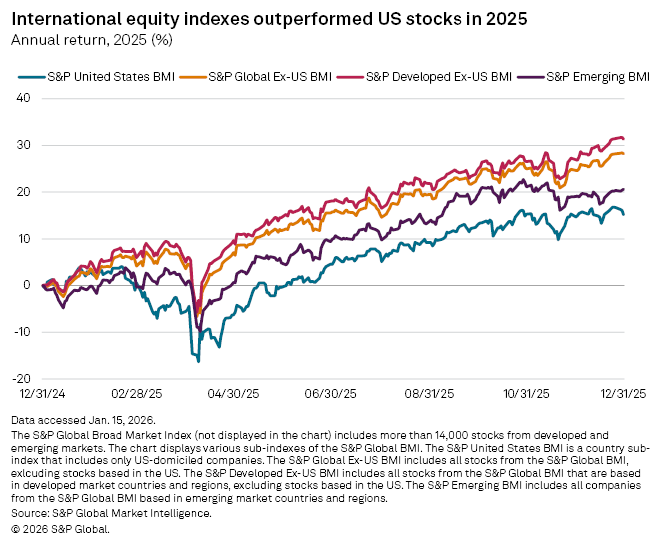
In early 2026, global equites have, in some measures, outpaced U.S. stocks. Data comparing global equity indices shows that broad international markets have sometimes delivered higher relative gains compared to the S&P 500, highlighting growing investor interest in diversification beyond the United States.
Meanwhile, international equity benchmarks like the S&P Developed Ex-US and S&P Emerging BMI indices outperformed their U.S. counterparts in 2025, driven by weaker dollar dynamics, fiscal policies, and regional growth opportunities.
Tariffs, Trade Policy & Market Reactions
Trade policy, including tariffs between major economies, has contributed to market volatility. For example, tariff threats and trade disputes have at times triggered sharp market reactions, such as notable selloffs in U.S. equities in early 2026. These dynamics illustrate how geopolitical developments can shift investor expectations and dilute confidence in certain sectors.
Sector Trends: Technology, AI & Defensive Plays
Technology stocks, particularly those linked to artificial intelligence, have had a leading role in market movements. While some AI-driven equities have lifted major indices, concerns over possible overvaluation and profit moderation have created skepticism. Investors are also led to allocate more cautiously, balancing growth stocks with defensive sectors.
Market Valuations and Forward Outlook
Valuations remain elevated in several markets, raising questions about future returns and risk adjustment. Analysis of forward earnings and price-to-earnings ratios suggests that while markets may continue to appreciate moderately, elevated valuations may limit upside without strong earnings growth.
Scenario analysis shows a range of potential outcomes for the S&P 500 in 2026—from moderate gains if current multiples hold, to possible downside if earnings slow—emphasizing the need for cautious investment positioning.
Investor Sentiment and Retail Participation
Retail investor sentiment remains bullish in many regions. Surveys reveal that a majority of individual investors plan to increase stock exposure in 2026, with AI themes seen as a primary driver of future market growth, particularly among younger investors.
Impact of Geopolitical Risk & Macro Uncertainty
Geopolitical tensions, such as conflicts in the Middle East or trade tensions, have contributed to bouts of risk aversion and safe-haven flows into assets like gold and bonds. Such dynamics can lead to sudden market swings, underscoring the interplay between geopolitics and financial markets.
Corporate Earnings: A Key Market Driver
Corporate earnings remain a pivotal force behind market performance. Recent earnings forecasts in Europe have been revised to reflect more stable outcomes, defying prior expectations of deeper downturns. Although revenue growth remains modest, better-than-expected profit results help sustain investor interest.
Strategies for Investors in 2026
In this mixed and uncertain environment, diversification across geographies and sectors becomes crucial. Investors are advised to balance between growth themes like technology and AI, and quality defensive plays such as healthcare and financials. Additionally, monitoring macroeconomic data such as inflation, interest rates, and GDP growth will help inform strategic decisions.
Conclusion: Balanced Outlook Amid Uncertainty
The global share market in 2026 exhibits both opportunities and challenges. While emerging markets and diversified international equities offer growth prospects, elevated valuations and macro risks underline the importance of disciplined investment strategies. Market participants should stay informed about economic indicators, sector trends, and geopolitical events to navigate this dynamic landscape effectively.